Tutorial · 12 minutes
How to trade crypto on BitMEX without blowing up in week one
Almost every trading guide teaches you where the buttons are. The buttons are not the problem. What ends accounts is misunderstanding what a perpetual swap costs to hold, what the leverage slider actually does to your survival distance, and what happens to a deposit sent over the wrong network. This walkthrough covers those first.
What you are actually trading
Three different instruments sit behind similar-looking charts, and choosing the wrong one is a slow, quiet leak rather than a loud mistake.
Spot
You buy the asset and own it on the platform. No leverage, no expiry, no funding. If the price falls fifty percent you still hold the same number of coins. This is the only one of the three that can be withdrawn to your own wallet.
Dated futures
A contract that settles on a fixed date. No funding payments; instead the price carries a basis to spot that converges toward expiry. Useful for expressing a view over a defined horizon without paying a running cost.
Perpetual swaps
The instrument the venue is known for. No expiry, and a periodic funding payment exchanged between longs and shorts keeps it anchored near spot. This is the product where holding costs money — or occasionally pays you — simply for the passage of time.
Intraday: perpetuals are fine, funding barely bites. Weeks: a dated future often costs less than repeated funding payments. Months or longer: buy spot, withdraw it, and stop paying anyone to hold your position.
Depositing without losing the transfer
This is the single step where money vanishes irreversibly, so it gets its own section. Modern stablecoins exist on many chains, and the same-looking address format is used across several of them. Sending USDT over BNB Chain to an address the platform generated for Tron does not bounce. It goes somewhere, and that somewhere is not your account.
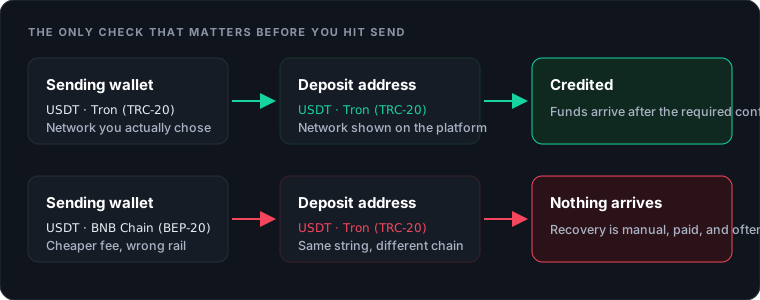
Read the network on the deposit page. Read the network in your sending wallet. Say them out loud. Send a small test amount, wait for it to credit, and only then send the rest. Recovery of a wrong-chain transfer is manual, chargeable and frequently impossible — and no support team can reverse a confirmed blockchain transaction.
A second check belongs here too. Some assets require a memo or destination tag. Omitting it produces the same outcome as the wrong chain: the funds arrive somewhere, unattributed, and getting them credited becomes a support case rather than a transaction.
Margin modes and the leverage slider
Two settings decide how much of your account a single bad trade can reach.
Isolated margin assigns a fixed amount of collateral to one position. If the trade goes wrong, that amount is what you lose — the rest of the account is untouched. This is the correct default for anyone still learning, and honestly for most people afterwards.
Cross margin lets the whole balance act as collateral. It reduces the chance of being liquidated early on a position that eventually recovers, and it increases the chance that one position takes the entire account with it. Experienced traders use it deliberately, usually while running several offsetting positions.
The order types that actually matter
Every venue offers a long menu. Five entries cover almost everything a retail trader needs, and knowing which of them pays the spread is worth real money over a year.
| Order | What it does | Fee side | Use it when |
|---|---|---|---|
| Market | Fills immediately at whatever price is available | Taker | You need out now and price matters less than speed |
| Limit | Rests on the book until price reaches your level | Maker, if it rests | Default for entries; you set the price you accept |
| Stop-market | Becomes a market order once a trigger price prints | Taker | Protective exits where certainty of execution wins |
| Stop-limit | Becomes a limit order at a trigger price | Depends | You want price control, and accept it may not fill |
| Post-only | Cancels rather than crossing the spread | Maker only | Fee-sensitive entries where you can wait |
Fee treatment of each order type, the current maker and taker schedule and any tiered discounts are set by the operator — check the live fee page at bitmex.com before assuming a rate.
A stop-limit stop-loss can fail to protect you in exactly the conditions you bought it for. If price gaps straight through your limit, the order rests unfilled while the position keeps losing. For protective exits, a stop-market is usually the honest choice.
Funding: the cost that scales with time, not size
A perpetual swap has no expiry, so something has to keep its price close to spot. That something is funding: at set intervals, one side of the market pays the other. When the perpetual trades above spot, longs pay shorts. When it trades below, shorts pay longs.
The rate is small per interval and enormous when annualised. A rate that looks like a rounding error on the screen can, held continuously, cost more than every commission you pay in a month. This is the mechanism behind a specific and very common experience: the trade was right, the position was held for three weeks, and the account still shrank.
There is a second lesson buried in the number. Persistently high positive funding means the market is crowded long, and crowded positioning is exactly what liquidation cascades feed on. Funding is a risk signal as much as a cost line.
Check the current funding rate and the predicted next one. If you are on the paying side and the plan is to hold for days, price the whole holding period — or switch to a dated future, where the cost is in the basis and known up front.
How liquidation really works
Liquidation is not a penalty. It is the venue closing a position whose collateral no longer covers its maintenance margin, so that the loss does not spill onto everybody else. Three details decide when it happens to you.
Mark price, not last price. The trigger references a mark price derived from an index of external venues rather than the last trade on this book. That is protective: a thirty-second wick caused by one thin order book should not liquidate correctly-margined positions, and using a mark price is what stops it.
Maintenance margin sits above zero. You are closed out before the position is fully underwater, and the gap between initial and maintenance margin is where your buffer actually lives.
Leverage sets the distance. This is the number people misread. Leverage does not change your expected return; it changes how far price can move before you stop having an opinion.
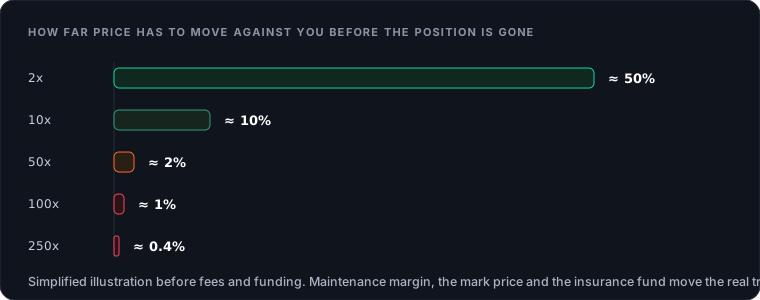
Two more mechanisms are worth knowing because they explain outcomes that otherwise look unfair. The insurance fund absorbs the shortfall when a liquidated position closes worse than its bankruptcy price, which is what usually prevents negative balances. Auto-deleveraging is the backstop when the fund cannot cover it: the most profitable, most leveraged traders on the opposite side have positions closed to balance the book. If you have ever had a winning position closed during a violent move, this is why.
A repeatable routine, start to finish
Discipline is not a personality trait, it is a checklist you follow when the position is moving and your judgement is not at its best.
-
Fund the account on the correct network
Copy the deposit address from the platform, confirm the asset and the network match exactly on both sides, and send a small test amount first. A correct address on the wrong chain is the most common way people permanently lose a transfer.
-
Pick the contract, and know what settles it
A perpetual swap never expires and charges or pays funding periodically. A dated future expires on a set date with no funding. Spot is the asset itself with no leverage. These behave differently over time even when the price chart looks identical.
-
Choose isolated margin while you are learning
Isolated margin caps the loss on a position at the margin assigned to it. Cross margin lets the whole account balance defend one position, which sounds generous until a single bad trade takes everything with it.
-
Size the position from your stop, not from the leverage slider
Decide the maximum you will lose on the trade, decide the price at which the idea is wrong, and let those two numbers determine size. Leverage then becomes an output rather than a choice.
-
Enter with a limit order and attach the exit before you look away
A resting limit order usually costs less than a market order and avoids paying the spread. Set the stop-loss and the take-profit in the same session as the entry — the intention to add them later reliably evaporates.
-
Track funding, not just price
Holding a perpetual through many funding intervals is a running cost that can exceed your commission several times over. Check the current and predicted rate before holding a position overnight.
-
Withdraw profits on a schedule
Decide in advance what leaves the platform and when, then move it to a wallet you control. Balances that stay because there was never a rule tend to stay through the events that matter.
Simpler alternative
If the funding rate maths made you tired, that is useful information
Buying spot on a licensed platform and moving it to a wallet you control has no funding, no maintenance margin and no liquidation price. For most people accumulating over years, that is the strictly better trade.
Compare spot fees and payment options
External link, opens in a new tab.
The mistakes that end accounts
None of these are exotic. All of them are common, and every one is avoidable with a rule written down before the trade.
- Leaving the leverage slider where you found it. Set it deliberately every single time, or size from the stop and let it fall out of the maths.
- Moving the stop. Widening a stop because price is approaching it converts a planned small loss into an unplanned large one. If the level was wrong, the trade was wrong.
- Adding to a losing position. Averaging down on leverage moves your liquidation price toward the market. It is the mechanism behind most total account losses.
- Trading the illiquid contract. Thin books mean brutal slippage on entry and worse on exit, and a wick that liquidates you at a price nobody else traded.
- Leaving everything on the platform. Custodial risk is real and independent of your trading skill. Withdraw on a schedule.
- Revenge trading after a liquidation. The account is not the problem at that point; the next twenty minutes are. Close the app.
Your seed phrase is never required to trade, deposit, verify or withdraw on any exchange. Two lines, worth repeating on every page: write it on paper, keep it offline, and never type it into a screen because someone told you to.
When you are ready to move funds off the platform — and you should plan to — read the exit-planning guide. It covers how to tell a real wind-down from a recycled rumour, and how to withdraw calmly instead of during a queue.
Frequently asked questions
What is the minimum to start trading on BitMEX?
Technically small — contracts are denominated so that modest positions are possible. Practically, the meaningful minimum is whatever amount lets you take a position sized to a sensible stop without the fee being a large share of the trade. Deposit and withdrawal minimums per asset are published by the operator at bitmex.com.
What is the difference between a perpetual swap and a futures contract?
A dated future has an expiry and settles on that date. A perpetual never expires; instead, a periodic funding payment between longs and shorts keeps its price tethered to spot. If you are long a perpetual while funding is positive, you pay that funding — every interval, whether the trade is winning or not.
How is the liquidation price calculated?
From your entry, your position size, the margin assigned and the contract’s maintenance-margin requirement, measured against the mark price rather than the last traded price. Using a mark price is deliberate: it prevents a thin-liquidity wick on a single venue from liquidating positions that are not genuinely underwater.
Can I lose more than I deposited?
On a well-run venue with an insurance fund and auto-deleveraging, negative balances are rare, and isolated margin caps your exposure at the margin assigned to the position. It is not a guarantee. In extreme, gapping markets, loss beyond the position margin is possible on any leveraged venue.
Do I need a wallet to trade?
To trade, no — the platform custodies your balance. To hold safely, yes. Once trading is done, withdraw to a wallet whose keys you control. The custody explainer covers why that split matters.
Is a trading bot or copy trading a safe way to start?
Automation multiplies whatever the strategy already does, including losing. Copy trading adds a second problem: leaderboard performance is usually survivorship, and the trader you are copying has different capital, different risk tolerance and no obligation to tell you when they change approach. Learn to size a position manually first.
Next step
Exit planning and shutdown rumours
How to withdraw before everyone else decides to.
Keep reading →Install the app safely
Clone detection, permissions and the twenty-minute hardening checklist.
Keep reading →Login and 2FA troubleshooting
What each error state means and the fix that works.
Keep reading →