Risk analysis
Is BitMEX closing? Read this before you join a withdrawal queue
Every large exchange gets a closure rumour eventually. Some of them turn out to be true, which is exactly why the false ones are so effective. This page separates the signals that deserve a reaction from the noise that does not — and lays out an exit routine you can run calmly, on a normal Tuesday, long before you need it.
Where things actually stand
As of this review there is no announced wind-down. The platform is operating, the app is published, and no regulator has issued a notice suspending it. If that changes, the change will appear first on the operator's own channels — a status page, a blog post, an email to account holders — with dates attached and a withdrawal window specified.
The rumours persist for structural reasons rather than because someone knows something. The 2020 US enforcement actions remain highly linkable and are routinely republished without a date. Regional service changes get reported as global closures. And an industry that produced FTX, Celsius and a long list of smaller failures has trained everyone to believe the worst version of any headline — a reasonable instinct, badly calibrated.
A closure claim without a link to the operator's own domain is not information. Check bitmex.com and its status page before you check anything else, and before you tell anyone.
Signal, noise, and "get out regardless"
Categorise what you are looking at before deciding what to do. The third column is the important one: some warning signs have nothing to do with a closure announcement and matter more than any of them.
Real signal
- — An announcement on the operator’s own domain with dates
- — A published withdrawal window and a deadline
- — A regulator’s notice naming the entity
- — Withdrawals suspended for all assets at once, confirmed on status pages
Noise
- — A screenshot with no link
- — An article recycling 2020 enforcement news without a date
- — One asset paused for a chain upgrade
- — "Insider" claims in a group chat that also sells signals
Act now anyway
- — Your own withdrawal has been pending far beyond the normal window
- — Support has stopped answering an open ticket entirely
- — The platform starts offering unusually high yields to keep deposits in
- — Executives depart and nobody explains why
What the failures of the last cycle actually taught us
The useful lesson from the collapses of 2022 is not "exchanges are bad". It is that the warning signs were visible and were ignored because acting on them felt like overreacting.
In every case, withdrawals slowed before they stopped. Support response times degraded before the announcement. Yields on idle balances rose at precisely the moment the platform most needed deposits to stay put. Executives left. And the last honest communication was always more optimistic than the reality — necessarily so, because an operator that says "we may not survive" guarantees it will not.
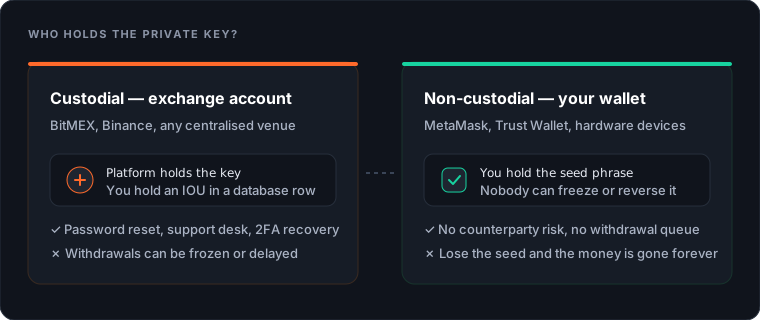
Which means you cannot outsource this judgement to the platform's own statements. The only defence that works is structural: hold on the venue what you need to trade, and hold the rest where no announcement can reach it.
Three questions worth asking about any venue you use
None of these require inside knowledge, and all three can be answered in an afternoon. Where is the entity actually incorporated, and who supervises it? A licence in a jurisdiction with a real supervisor and a complaints process is worth more than a registration in a place that issues them by post. What happens to customer assets in an insolvency? Some regimes require segregation and treat client assets as bankruptcy-remote; others leave you as an unsecured creditor. The answer is in the terms of service, and it is usually one sentence. How did the operator communicate the last time something went wrong? Search for their most recent incident report. A venue that publishes a detailed post-mortem with a timeline has told you something real about how it will behave next time.
Proof of reserves is not proof of solvency
Many platforms now publish reserve attestations. Read them carefully: assets without liabilities is a half-statement, and a Merkle-tree snapshot proves what was held at one instant, not what is held now and not what is owed. An attestation signed by an independent auditor covering both sides is meaningfully better than a self-published asset list, and most published reserves are the latter.
The exit routine, in order
Run this deliberately rather than urgently. Every step exists because skipping it has cost somebody their balance.
-
Verify the claim at the source before you act
Open the platform’s own status page, official blog and verified social accounts. A real wind-down is announced by the operator with dates and a withdrawal window, not by an anonymous post quoting an unnamed insider.
-
Close or hedge open positions first
Leveraged positions cannot be withdrawn, only closed. Reduce exposure before you touch the balance, and remember that a panic-driven market order in a thin book pays for the panic.
-
Cancel resting orders and disable automation
Stale limit orders and running bots will happily re-open exposure while you are trying to leave. Turn off API keys and cancel everything on the book before withdrawing.
-
Withdraw the collateral asset over a chain you have used before
This is not the moment to try an unfamiliar network to save a fee. Send a small test, confirm it credits in your wallet, then move the remainder.
-
Confirm settlement in your own wallet, not on the exchange screen
A "completed" status on the platform means it was broadcast. Check the balance in the destination wallet and the transaction on a block explorer before you consider the funds moved.
-
Close the account formally once the balance is zero
Revoke API keys, remove whitelisted addresses, download your full trade history for tax purposes, then submit the account-closure request. Export first — access to statements usually ends with the account.
The moment a closure rumour spreads, fake "emergency withdrawal portals" appear in search ads and social replies. They ask for your seed phrase or your login and 2FA code. No legitimate exit process ever requires either. Navigate by your own bookmark, always.
Closing your own account properly
If you are leaving for your own reasons — moving to a licensed venue, stopping derivatives trading, consolidating accounts — do the housekeeping in a sensible order.
Export everything first. Trade history, funding payments, deposits and withdrawals, in the widest date range available. Once the account is closed, retrieving statements becomes a support request, and your tax filing will need them.
Kill the automation. Delete API keys before anything else. A forgotten key with trading permission is a live position waiting to reappear.
Zero the balance, including dust. Small residual amounts below the withdrawal minimum can block a closure request. Convert dust into the asset you are withdrawing before you start.
Then submit the closure request. Expect identity records to be retained regardless — anti-money-laundering rules require it, and no platform can delete them on request. That is a legal obligation on them, not a dark pattern.
Where the money should go
Into a wallet you control, not straight into another exchange. If the reason for leaving is counterparty risk, moving from one custodian to another does not address it. A hardware wallet for long-term holdings and a smart account with recovery for everyday use is the 2026-appropriate setup — modern smart accounts support social recovery and spending limits, so self-custody no longer means one sheet of paper standing between you and total loss.
Write the seed phrase on paper and store it offline, in more than one place. Never type it into any website, app or support chat — no legitimate service will ever ask for it.
Once the balance is safe, the useful next question is where you trade or buy from here. Our platform overview covers how to compare venues on custody and fees rather than on marketing, and the trading walkthrough explains the mechanics that carry over to any venue you choose.
Plan the exit before you need one
Keep the trading balance small and the withdrawal path proven
A licensed platform with local bank rails, a verified identity and a whitelisted wallet address turns withdrawal from an event into a routine. Set it up while nothing is happening — that is the whole point.
External link, opens in a new tab.

Frequently asked questions
Is BitMEX closing down in 2026?
There is no announced wind-down. The platform continues to operate, and the only announcements that count are the ones published by the operator on its own channels. Treat any claim of closure that does not link to bitmex.com as unverified.
Why do "BitMEX closing" headlines keep appearing?
A mix of causes: the 2020 US enforcement actions still surface in search results without dates attached; the withdrawal of a specific product or a regional service gets reported as a full closure; competitors and content farms recycle old news for traffic; and genuine industry consolidation makes every rumour plausible enough to click.
How do I close a position rather than the account?
Use the close or reduce-only control on the position itself rather than opening an opposite trade, which on some account setups creates a second position instead of flattening the first. Reduce-only guarantees the order cannot accidentally open exposure in the other direction.
How long does closing an account take?
The balance withdrawal is the slow part and depends on network confirmations and any security cooling-off period after recent credential changes. The closure request itself is typically processed within days. Record-retention rules mean the operator keeps your identity records afterwards regardless.
What happens to my funds if an exchange really does shut down?
In an orderly wind-down, the operator publishes a withdrawal window and users move funds out. In a disorderly failure, balances become claims in an insolvency process that can take years and rarely returns everything. That gap between the two scenarios is the entire argument for self-custody of anything you are not actively trading.
Should I move everything out at the first rumour?
Moving to self-custody is a good idea on its own merits and on your own schedule. Doing it inside a panic, at whatever the network fee spikes to, into a wallet you set up in a hurry, is how people lose funds to their own haste rather than to the platform.
Next step
Trading mechanics that carry over
Margin, funding and liquidation explained once, useful on any venue.
Keep reading →If you are locked out mid-exit
2FA recovery, session revocation and the compromise checklist.
Keep reading →US access rules
Why routing around a restriction shows up at the withdrawal screen.
Keep reading →