Independent review · updated August 2026
The BitMEX app, judged on withdrawals rather than screenshots
Every exchange looks good in a product shot. What matters is how the platform behaves when the order book thins out, when funding flips hard against you, and when you finally ask for your money back. This is a plain-English breakdown of the BitMEX live trading app — the parts worth using, the parts that quietly cost you, and the checks to run before a single satoshi lands.
This is not the official website of BitMEX. Informational content only.
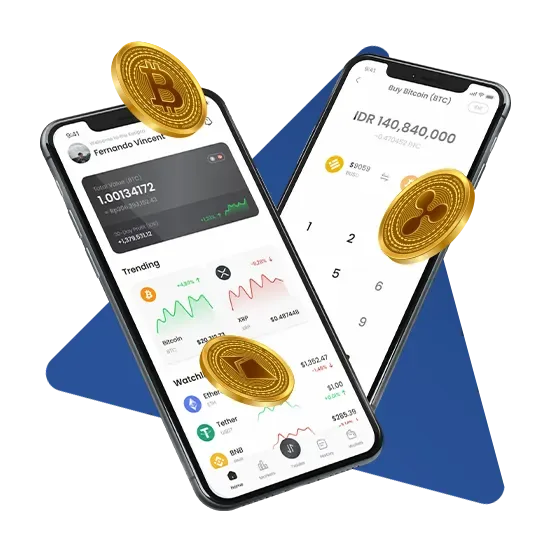
- Account model
- Custodial
- Headline leverage
- Up to 250x
- Identity checks
- Mandatory
- Fiat on-ramp
- Limited
Product specifications summarised from the operator's own product pages — bitmex.com. Verify before acting; contract terms change without notice.
Who this platform is actually built for
BitMEX launched in 2014 and spent most of the following decade as the venue where the perpetual swap was invented and stress-tested. That history explains the product you install today: a derivatives terminal first, a place to buy coins second. The order book, the funding mechanism and the liquidation engine are the point. Everything else — spot pairs, the mobile wallet screen, the earn products — grew around that core later.
If you are an active trader who thinks in basis points, cares about funding rates and wants deep liquidity on Bitcoin contracts, the app makes sense. If you opened this page because you want to buy your first $200 of Bitcoin on a phone, you are looking at the wrong category of product, and the honest advice is to walk away before you deposit. A derivatives exchange will happily let a beginner take a 50x position at 2am. It will not stop you, and neither will the app.
The one distinction that decides everything else
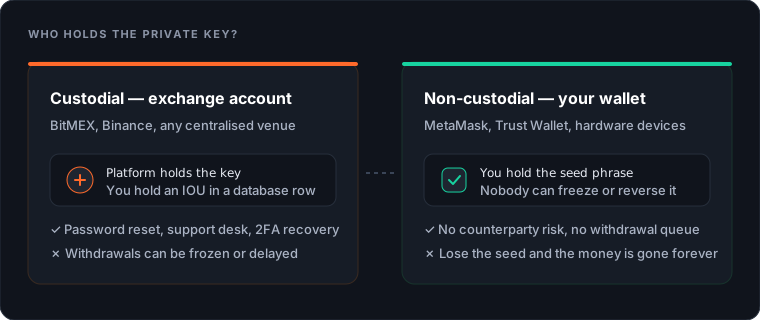
Before comparing fees or interfaces, get this straight, because almost every expensive mistake in crypto traces back to it. An exchange account — BitMEX, Binance, Bybit, any of them — is custodial. The platform holds the private keys. Your balance is a row in their database and a legal claim against the company. That is why a support desk can reset your password, and it is also why a regulator, a court order or an internal incident can freeze your withdrawal.
A non-custodial wallet — MetaMask, Trust Wallet, a hardware device — is your own safe. You hold a seed phrase, and that seed phrase is the money. Nobody can freeze it, nobody can reverse a transaction for you, and nobody can help you if you lose it. There is no password reset. There is no customer support. That trade-off is the whole game.
Your seed phrase is never needed to log into an exchange app, verify an account, claim an airdrop or unlock a withdrawal. Anyone who asks for it — including a convincing "support agent" — is stealing from you. Write it on paper, store it offline, and never type it into a screen that someone else linked you to.
What the live trading app does well
Judged as a mobile client for an existing derivatives account, it holds up. Order entry is fast, the position panel shows liquidation price and margin ratio without three taps of digging, and the charting is responsive enough to manage a trade rather than merely watch one. Push notifications on fills and margin calls arrive quickly, which matters more than any charting feature when a position is moving against you at 3am.
The app also inherits the exchange's biggest genuine asset: engineering discipline. This is a platform that has processed enormous liquidation cascades. Its uptime record through violent markets is better than most of its competitors, and its public post-mortems after the incidents it did have were unusually candid by industry standards.
And where it quietly costs you
- Default leverage is not a suggestion your account respects. Contracts open with high leverage available, and a mistimed slide of a slider is the difference between a drawdown and a liquidation.
- Funding is a recurring cost, not a footnote. Holding a perpetual through many funding intervals can cost more than the spread and commission combined. Traders who "only pay maker fees" routinely lose more to funding than to fees.
- Fiat rails are thin. Getting money in and out in your local currency is far easier on a regulated spot platform, and many people end up running two accounts for exactly this reason.
- Onboarding is heavier than it used to be. Verification is mandatory, and access is geographically restricted — see the notes on access from the United States.
The cost stack nobody puts in the marketing copy
Your real cost of trading is five separate charges wearing one name. Understanding which ones scale with position size and which scale with time is what separates a profitable month from a confusing one.
| Cost | When it hits | Scales with | How to reduce it |
|---|---|---|---|
| Taker commission | Every market order | Notional size | Use limit orders that rest on the book |
| Maker rebate or fee | When a resting order fills | Notional size | Post liquidity; check the current tier schedule |
| Funding payment | Every funding interval you hold a perp | Time held | Avoid holding a crowded side; use dated futures |
| Slippage | Immediately, invisibly | Order size vs book depth | Split large orders; avoid illiquid contracts |
| Network withdrawal fee | Moving coins off the platform | Chain congestion | Batch withdrawals; pick the cheaper settlement chain |
Commission tiers, funding intervals and withdrawal minimums are set by the operator and revised periodically. Always read the live schedule on bitmex.com rather than a third-party summary — including this one.
Lower friction on the fiat side
Move money in and out without the derivatives paperwork
If most of your activity is buying, holding and occasionally selling, a licensed spot platform with card, SEPA and bank rails will cost you less in fees, less in time, and far less in stress than routing everything through a derivatives venue.
External link. We are not paid to name a specific venue in the editorial text above.
Leverage: the number that decides how long you last
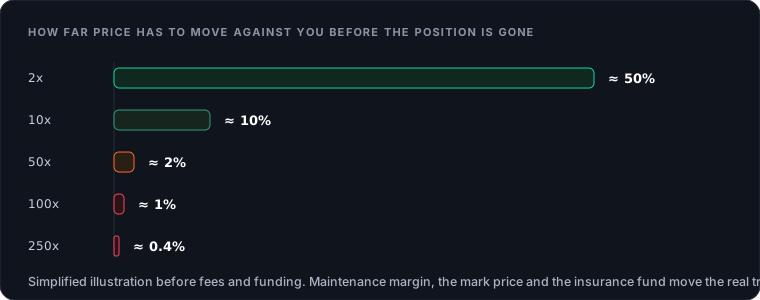
Leverage does not increase your edge. It compresses the distance between your entry and the price at which the exchange closes you out. At 2x, price has to roughly halve before you are gone. At 100x, a one percent move — the sort of thing that happens during a routine news headline — is enough. The headline "up to 250x" is a marketing number, and treating it as a target is the single most reliable way to lose a deposit.
There is a second-order effect worth internalising. High leverage clusters liquidation prices into narrow bands, and those bands become targets. When a cascade starts, it does not stop politely at your stop-loss — it runs through every liquidation level stacked behind it. This is why positions that "should have survived" get closed during a thirty-second wick.
Size the position from the stop, not from the leverage slider. Decide what you are willing to lose, decide where the trade is wrong, and let those two numbers produce the size. If the resulting position feels too small to be interesting, that is information about the trade, not about the position size.
Hardening the account before it holds anything
The overwhelming majority of "exchange hacks" reported by individual users are not exchange hacks. They are credential stuffing against a reused password, a SIM swap against SMS two-factor authentication, or malware on the machine where the seed phrase was typed. All three are preventable in under twenty minutes.
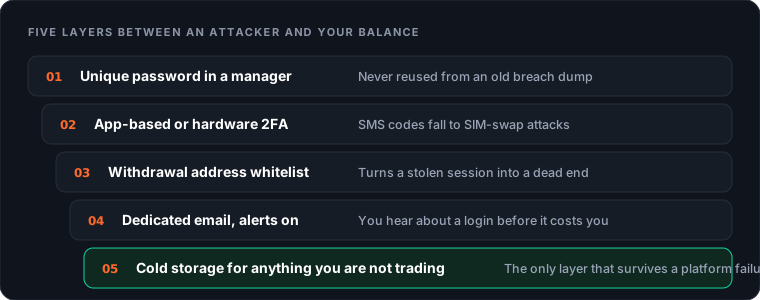
Two of those layers deserve emphasis. Withdrawal address whitelists convert a stolen session into a nuisance rather than a catastrophe: even with full account access, an attacker can only send funds to addresses you approved earlier, and adding a new one triggers a delay. App-based or hardware 2FA removes your phone number from the attack surface entirely — and a phone number is the easiest thing about you to steal.
Then there is the layer no exchange can give you. Anything you are not actively trading should sit in a wallet whose keys you hold. Not because a specific platform is untrustworthy, but because the history of this industry is a list of platforms that were trustworthy right up until they were not. Our guide to shutdown rumours and exit planning covers how to get funds out calmly rather than during a panic.
What changed by 2026, and why it matters to you
Three shifts have redrawn the map since the last cycle, and any review written before them is worth less than it looks.
Regulation stopped being optional
The European MiCA framework moved crypto service providers into a licensing regime with capital, custody-segregation and disclosure requirements. The practical effect for a retail user is that venues now sort into two piles: those with a licence in your jurisdiction and those that geo-block it. Offshore derivatives platforms increasingly sit in the second pile. That is not a judgement about their engineering — it is a fact about where you can legally and reliably move money.
Smart accounts and account abstraction
On the self-custody side, ERC-4337 style smart accounts have made "your wallet" much less terrifying. Social recovery, spending limits, session keys and gas sponsorship mean a non-custodial wallet no longer implies a single sheet of paper standing between you and total loss. The old argument that beginners must use an exchange because seed phrases are too dangerous is now substantially weaker.
Custody transparency became a differentiator
Post-2022, proof-of-reserves attestations became table stakes. Read them properly: an attestation of assets without a matching statement of liabilities tells you very little, and a snapshot taken on a known date tells you less than a continuous system. When a platform publishes reserves, check whether an independent auditor signed the liabilities side too.
Start with the guide that matches your problem
Installing the app safely
How to verify you are downloading the real client, on iOS and Android, and what to check before signing in.
Keep reading →Login and sign-up problems
Two-factor lockouts, verification loops, region blocks and the fixes that actually work.
Keep reading →Placing your first trade
Margin modes, order types, funding and the stop-loss discipline that keeps an account alive.
Keep reading →Shutdown rumours in 2026
How to tell a real wind-down from a recycled headline — and how to exit before it matters.
Keep reading →Access from the United States
What restricted access means in practice and why VPN workarounds end in frozen balances.
Keep reading →Frequently asked questions
Is the BitMEX app safe to keep coins in?
It is as safe as any custodial venue, which means the platform holds the private keys and you hold a claim. The engineering record is strong — the exchange survived years of hostile market conditions without a headline breach — but the structural risk never disappears. Keep trading collateral on the platform and long-term holdings in a wallet you control.
Does the BitMEX app require KYC?
Yes. Identity verification has been mandatory for all users since the platform completed its user verification programme; anonymous accounts no longer exist. Expect a government ID, a liveness check and proof of address for higher limits. The current requirements are published on the official BitMEX site.
What is the difference between the app and the web terminal?
The order types, margin engine and account are identical — the app is a client on the same infrastructure. What differs is workflow: the mobile client is built for monitoring, adjusting stops and closing positions, while ladder trading, dense multi-chart layouts and API key management are far easier on desktop.
Can I use the BitMEX app without leverage?
Yes. Spot pairs settle without margin, and on derivatives you can set leverage to 1x, which behaves like a fully collateralised position. Most account damage we see comes from traders leaving the default leverage untouched rather than from choosing it deliberately.
Which app should I install if I only want to buy and hold?
A derivatives venue is the wrong tool for buy-and-hold. You want a regulated spot platform with cheap fiat rails and a clean withdrawal path to a wallet you control — see our download and setup guide for how to evaluate one.
Get the boring part right first
A clean funding route, verified identity and a withdrawal address you control will save you more money than any indicator. Set that up once, then trade from a position of calm.
External link, opens in a new tab.